In the rapid expansion of 5G backhaul and metropolitan area networks (MAN), the most expensive asset is often not the hardware, but the fiber-optic cable itself. When a facility is limited to a single available fiber strand, traditional dual-fiber 100G links are no longer an option. This is where the QSFP28 100G BIDI 30km transceiver emerges as a critical bridge between standard 10km (LR4) and extended-reach 40km (ER4) solutions.
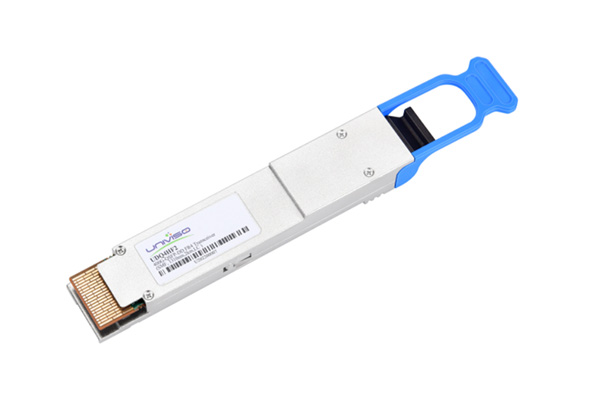 100GBase-ER QSFP28 single Lambda 30km(SMF, PSM4, BIDI 1304&1309nm,LC)
The core innovation of the 100G BIDI (Bidirectional) module lies in its use of Wavelength Division Multiplexing (WDM). Instead of using two separate fibers for transmit (Tx) and receive (Rx), the BIDI module utilizes a single LC simplex interface to handle both signals simultaneously at different wavelengths.
Wavelength Pairs: Typically 1271nm-Tx/1331nm-Rx and vice versa.
Modulation: Advanced PAM4 technology for high spectral efficiency.
Interface: Simplex LC connector (reduces cabling density by 50%).
Transmission Distance: Guaranteed 30km reach over G.652 Single-Mode Fiber (SMF).
| Module Type | Fiber Requirement | Max Distance | Cost Profile |
|---|---|---|---|
| 100G LR4 | Dual Fiber | 10km | Low |
| 100G BIDI 30km | Single Fiber | 30km | High ROI |
| 100G ER4 | Dual Fiber | 40km | Premium |
Historically, network planners had to choose between 10km (LR4) or jumping straight to 40km (ER4/ER4 Lite). However, 40km modules are significantly more expensive and often require specialized Forward Error Correction (FEC) settings or optical amplification. The 100G BIDI 30km offers a cost-optimized middle ground, providing ample margin for intra-city links and enterprise DCI without the thermal and budget overhead of 40km modules.
Deploying 100G at 30km over a single fiber is not without its challenges. Engineers must account for the Optical Link Budget. With a 30km span, chromatic dispersion becomes a factor. The BIDI 30km module is designed with high-sensitivity receivers to compensate for the signal attenuation that occurs over extended distances, ensuring that bit-error rates (BER) remain within the KP4 FEC limits.
For Univiso users deploying these in remote 8K video aggregation points, this means a more resilient link that can withstand the additional loss from patch panels and fiber splices common in field deployments.
As the demand for 100G bandwidth migrates from the core to the edge, efficiency is paramount. The QSFP28 100G BIDI 30km is more than just a transceiver; it is a fiber-conservation strategy. By halving the required fiber count while tripling the reach of standard LR4 modules, it allows operators to scale their networks sustainably and economically.
Headquarter address :Room 1603, Coolpad Building B, North District of Science and Technology Park, Nanshan District, Shenzhen,China.518057