In the high-stakes world of 100G metropolitan networking, the efficiency of the fiber plant is paramount. While dual-fiber LR4 has been the traditional workhorse, the 100G BIDI QSFP28 10km is fundamentally a triumph of optical filtering and photonic integration. Beyond the marketing buzz of "fiber saving," this module addresses the raw physics of chromatic dispersion and signal isolation in a single-strand ecosystem.
Fig 1: Internal assembly showing the integrated BOSA and WDM filter for 1271/1331nm isolation.
A "10km" rating is an engineering approximation. For mission-critical IP backhaul, we must audit the Optical Power Budget against the specific loss profile of G.652D fiber. In a 100G BIDI 10km deployment, the budget isn't just about distance; it's about surviving the insertion loss of multiple patch points and the aging of the glass.
| Parameter (Worst Case) | Univiso BX10 Spec | Engineering Margin (Safety) |
|---|---|---|
| Launch Power (Min) | -4.3 dBm | Aim for -3.0 dBm at Tx |
| Receiver Sensitivity (Avg) | -10.6 dBm | Keep Rx > -8.5 dBm |
| Total Link Budget | 6.3 dB | Maintain 2.0 dB Headroom |
Fig 2: Link budget decay curve factoring in splice loss and connector reflection (ORL).
The transition to 100G BIDI 10km moves us from NRZ to PAM4 (4-Level Pulse Amplitude Modulation). This quadruples the data density but significantly tightens the Signal-to-Noise Ratio (SNR). Field engineers must monitor the TDECQ (Transmitter and Dispersion Eye Closure Quaternary). A TDECQ value exceeding 3.4dB will likely trigger intermittent link flapping, even if the absolute light levels seem acceptable.
Note on Chromatic Dispersion: The 1331nm wavelength (used in BX10-D TX) experiences slightly more dispersion than the 1271nm wavelength over the same 10km span. In high-temperature environments, this delta can impact the PAM4 eye opening, making Univiso's high-grade DSP (Digital Signal Processing) essential for maintaining a stable Bit Error Rate (BER).
Fig 3: PAM4 Eye diagram showing the distinct four-level signaling required for 100G-BX10.
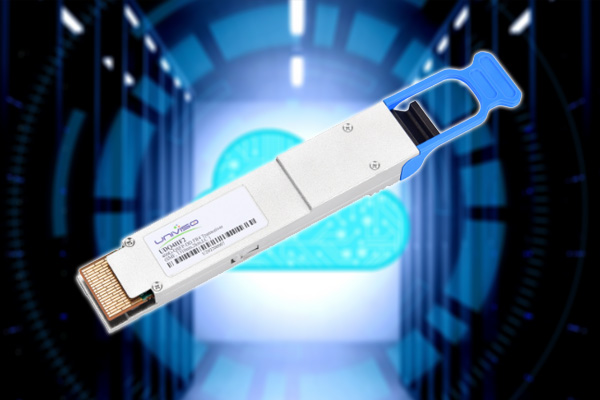
The QSFP28 100G BIDI 10km is a cornerstone for future-proofing networks where fiber scarcity is a reality. However, reliability is not guaranteed by the module alone—it is achieved through a rigorous audit of the optical path and an understanding of the photonic trade-offs between 1271nm and 1331nm. At Univiso, our engineering philosophy is simple: we don't just provide the transceiver; we provide the link integrity needed for uncompressed 8K and high-bandwidth IP fabrics.
Headquarter address :Room 1603, Coolpad Building B, North District of Science and Technology Park, Nanshan District, Shenzhen,China.518057